MediaSIGNAL
The Two-Speed Island: What Ibiza 2026 Is Actually Telling Us
A €70 million hyperclub topped the world poll in year one. Read the rest of the calendar and the split becomes impossible to miss.
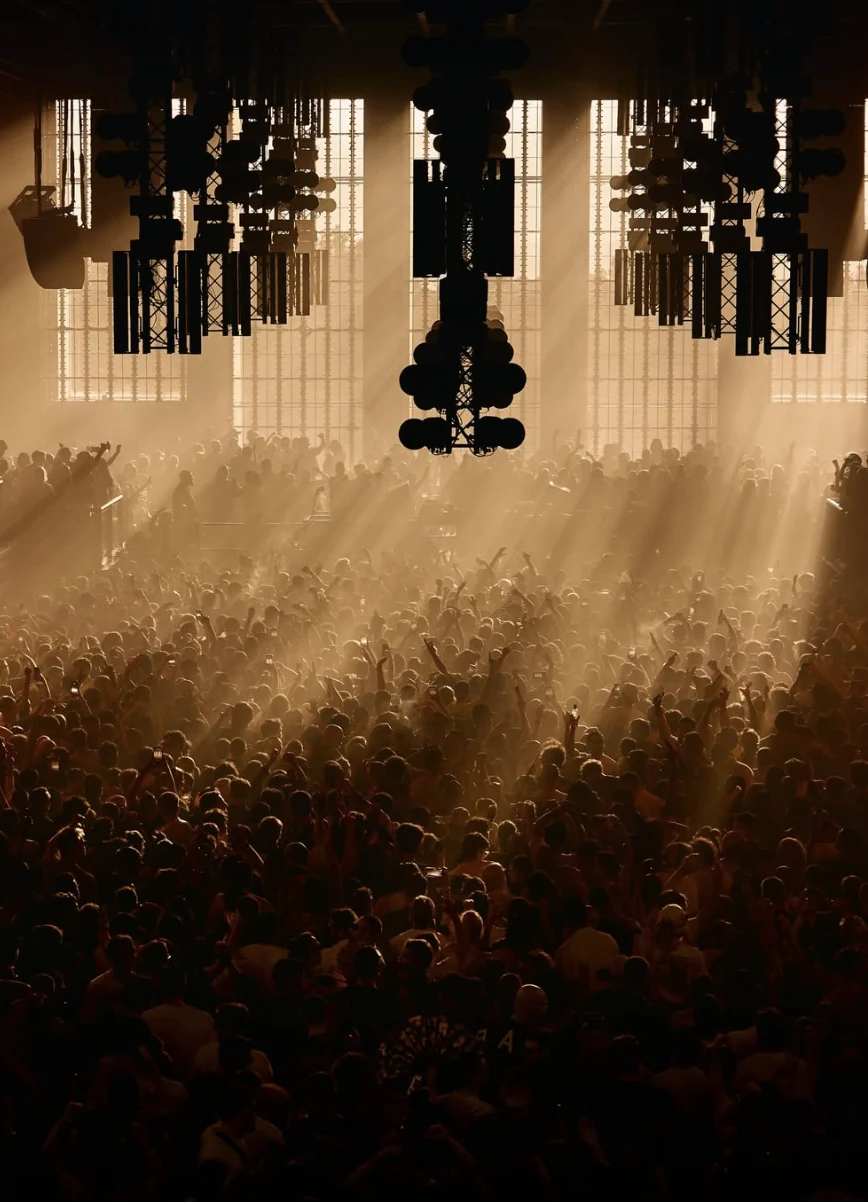
Something happened on Ibiza in 2025 that hadn't happened in over two decades of the DJ Mag Top 100 Clubs poll: a club that opened that same year went straight to number one. Not climbed. Debuted there. UNVRS (the "hyperclub" built on the bones of the old Privilege, reportedly for somewhere between 40 and 70 million euros, with room for around ten thousand people) walked in and took the top spot in its first season, and held it into 2026.
You can read that as a one-off. We read it as a verdict.
Because the number-one club in the world is now, structurally, an arena. It has a control room positioned like a cinema projection box. It has a custom L-Acoustics rig, kinetic lighting that reshapes the room nightly, a drone for the crowd shots, and a VIP balcony sold, in the club's own language, as the best seat in the house, a private table with a minimum spend redeemed against bottles. That last detail is the one that matters most, because it tells you what the room is optimised for. The best view at UNVRS is not on the dancefloor near the booth. It's above it, with a bottle.
Read the rest of the calendar
The hyperclub isn't an anomaly on the island. It's the loudest expression of where the whole top tier is heading, and the 2026 calendar makes the direction legible.
UNVRS itself runs a week of headline machinery: Jamie Jones brings Paradise on Wednesdays, FISHER on Thursdays, David Guetta on Fridays, elrow on Saturdays, Carl Cox on Sundays. And on Mondays (this is the tell) John Summit lands a nine-week residency under his Experts Only banner. An American festival headliner, fresh off back-to-back mainstages, taking a residency at the world's number-one club. Five years ago that sentence wouldn't have parsed. Elsewhere: Amnesia turns 50 and absorbs Glitterbox; Defected moves to Chinois; Swedish House Mafia takes its longest-ever Ibiza residency at Ushuaïa; Tomorrowland takes over Ushuaïa Wednesdays. The machine is getting bigger, more produced, more expensive, and more comfortable describing a night out as a "world-class experience."
The price followed the production. Over the last decade Ibiza entry roughly doubled (from the 40-to-60-euro range to 80 to 150) and a full night, by the time you've added drinks and transport, now averages somewhere near 270 euros. VIP tables run into the tens of thousands. None of this is hidden. The island has, fairly openly, repositioned itself from a party destination into a luxury entertainment capital. That's a legitimate business. We just want to be precise about what it is.
The honest part: the hyperclub is honest
Here's where we break from the easy take. The lazy move is to call UNVRS the death of the underground and walk off feeling pure. We won't, because it isn't true and it isn't interesting.
UNVRS is honest about being a spectacle. It promises a stadium-grade audiovisual event with hospitality bolted on, and it delivers exactly that. People come out genuinely moved. There's craft in it. The problem was never the hyperclub being clear about what it sells.
The danger is the imitation. The real risk in a two-speed island is the middle tier (the 500-to-1,500-capacity rooms) looking up at the number-one club and deciding the way to survive is to copy it. More LEDs, more table service, more production budget chasing a "premium experience," all of it sub-scaled and underfunded, none of it the thing those rooms are actually good at. A mid-size club that tries to out-spectacle an arena loses on the arena's terms. It has the one advantage the arena can never buy, and it spends its money pretending it doesn't.
What a room does that an arena can't
That advantage is proximity, and the kind of programming proximity allows.
In a ten-thousand-cap room, the set has to be legible from two hundred metres away, which means it has to be built out of peaks: moments designed to read at distance and on a phone screen. The music narrows to fit the architecture. That's not a moral failing; it's physics. A drop has to do a lot of work in a space that big.
In a room of a few hundred, none of that is necessary. The DJ can take an hour to get somewhere. They can play a record that risks losing you, because if it lands, everyone feels it at once and the booth knows immediately. The crowd is close enough to be part of the take. That's where a long set lives, where a hypnotic groove makes sense, where a selector can actually select instead of just deliver. It's the whole reason the deep, minimal end of this music exists. It was built for rooms where you don't need to shout.
So the question Ibiza 2026 poses to anyone running a small collective isn't "how do we get bigger." It's the opposite, and it's harder: what is the thing only a room can do, and are we actually doing it, or are we quietly imitating the arena with a smaller budget?
We know which side of the split we're on. The island just made the two sides easier to see. The honest response to a number-one hyperclub isn't to resent it. It's to be unmistakably, structurally different, and to make that difference the reason people come.